

Dan Bernyk
Shift
Thames Art Gallery, Chatham
(No longer on public display)
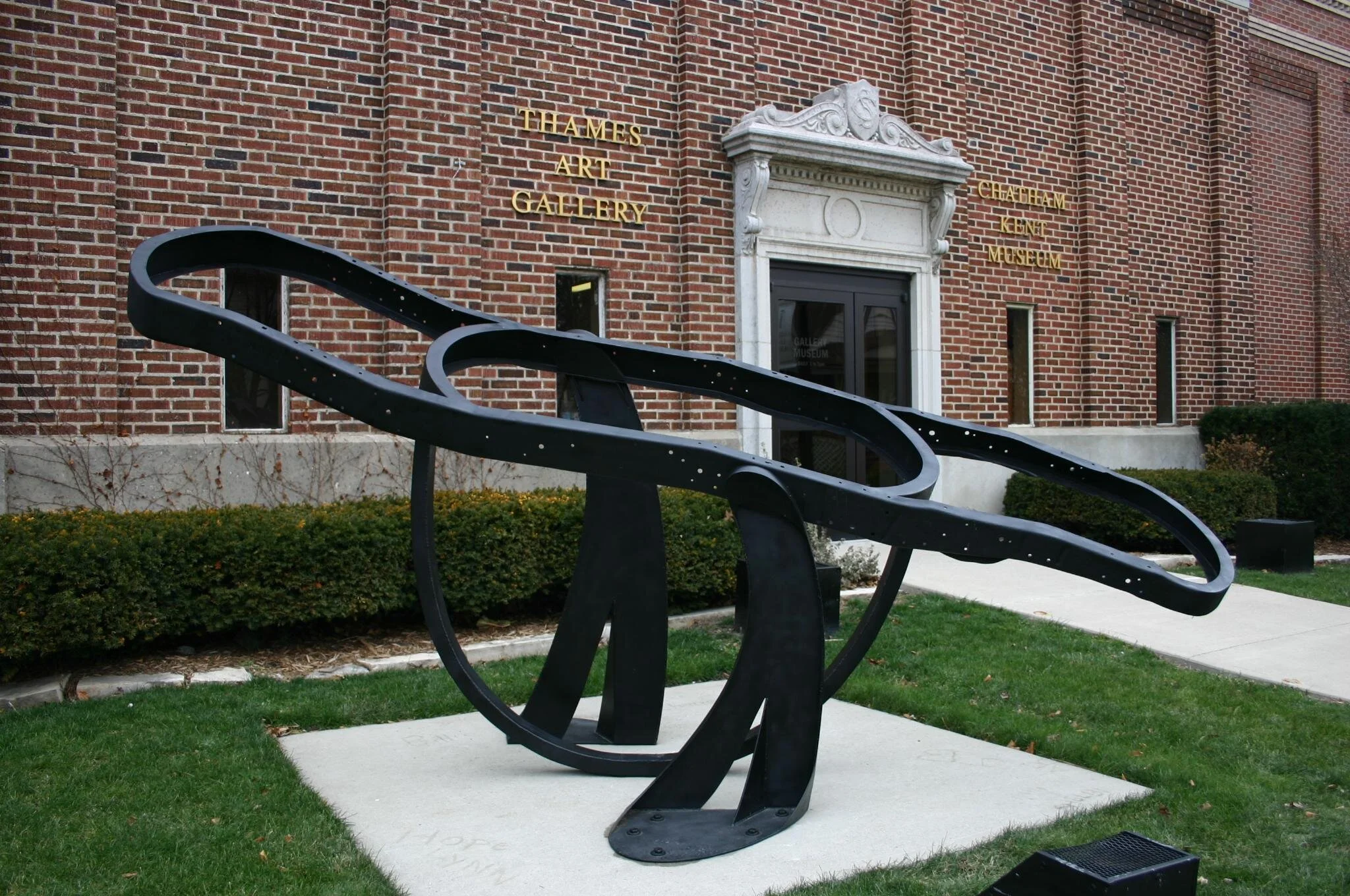
[O]ne of the strongest motives that lead men to art and science is escape from everyday life with its painful crudity and hopeless dreariness, [and] from the fetters of one's own ever-shifting desires. — Albert Einstein (40)
‘Shift’ in the Oxford English Dictionary is defined as the movement or change from one position to another, or the ability to change gears. As Einstein expresses, by shifting we can “escape from everyday life.” Within an aesthetic context / within an artistic context, the ability of the artist to shift materials from the natural order to one of compelling metaphor, representation or symbolism is what makes the creative act most distinctive.
Acquiring and transforming, whether to express a deeply personal experience, or to make a collective social commentary, can certainly be said to be at the centre of Dan Bernyk’s Shift. In Bernyk’s most recent sculpture, the curving structural channels of steel become a fluid expression, which, according to Bernyk, “speaks to the audience about a very assembled form, that keeps the viewer's eye moving through the flat channelled surfaces.” The integration of surface and line carries the principal form into the tradition of 60’s minimalist sculpture. However, the very nature of the balanced structure also expresses a post-millennial art aesthetic, one that critiques the pure “minimalist” drive towards personal detachment. For that reason, Shift assimilates the cultural divide, where factory production skills and assembly-line efficiencies meet the specific sphere of contemporary sculpture.
In obtaining a 1966 Ford truck frame, Bernyk uses the primary support structure of the vehicle to make a thought-provoking commentary on today’s hyper-informed culture. It is not surprising that, like many minimalist sculptors of the post-WWII era before him, Bernyk challenges Walter Benjamin’s concept of the loss of artistic “aura” in the machine age while still meditating on Aldous Huxley’s notion of the industrial age’s ‘religion’ of Fordism. As a result, the recognizable and invisible nostalgia—and the fact that Shift had a previous life as a vintage truck—resonates with an fluid openness in which a routine of automotive manufacture is elegantly crafted into interactions of floating and freestanding axes. Using this pure, skeletal backbone, the raw material becomes a contemporary sculptural meditation that amalgamates the traditions of Russian constructivism with Canadian post-minimalism. Utilizing the techniques of extreme simplicity, formal efficiency and restricted colour, Bernyk rattles the gears of the viewer’s imaginative experience of a 1966 Ford truck.
But what is truly being expressed in Bernyk’s Shift? The circularity of the central body is one that subtly nods to the ‘test track’ rationale of the automotive industry. The test track is an endless road trip that goes nowhere but back to the drawing board, and new models are tested as if their product line’s success is dependent on the continuous assault of going around and around and around. The ability of the viewer to travel around its negative-space core and physical perimeter is typical of a minimalist sculpture in which the ‘truth’ of its configured matter is released through the metaphor of passe-partout, which Jacques Derrida defined as the harmonizing of differences of both form and content. It is this metaphorical frame of harmonizing that Shift so elegantly expresses. Its central core, its key transformation case, is suspended, floating by its struts in such a way as to allow the viewer’s imagination to visually travel through, in, around, and out, along the channels of the road where we keep coming back to our starting position. Nothing is more pleasurable than drifting our gaze over the spaces and surfaces as if slipping from one gear to the next. At the same time, Bernyk quietly evokes the recycling reference of ‘old into new’ in order to offer a fresh understanding of past and future.
As the viewer approaches the work, we discover the surface essence revealed. The pitted frame of the vintage sub-structure echoes an era of auto manufacture that thrived in Windsor and its surrounding parts plants in Chatham. Revitalizing steel combines with memories of this past era to tender a new expression of future possibilities. Vintage and contemporary come together to offer the observer an “escape from the dreariness of everyday experiences.”
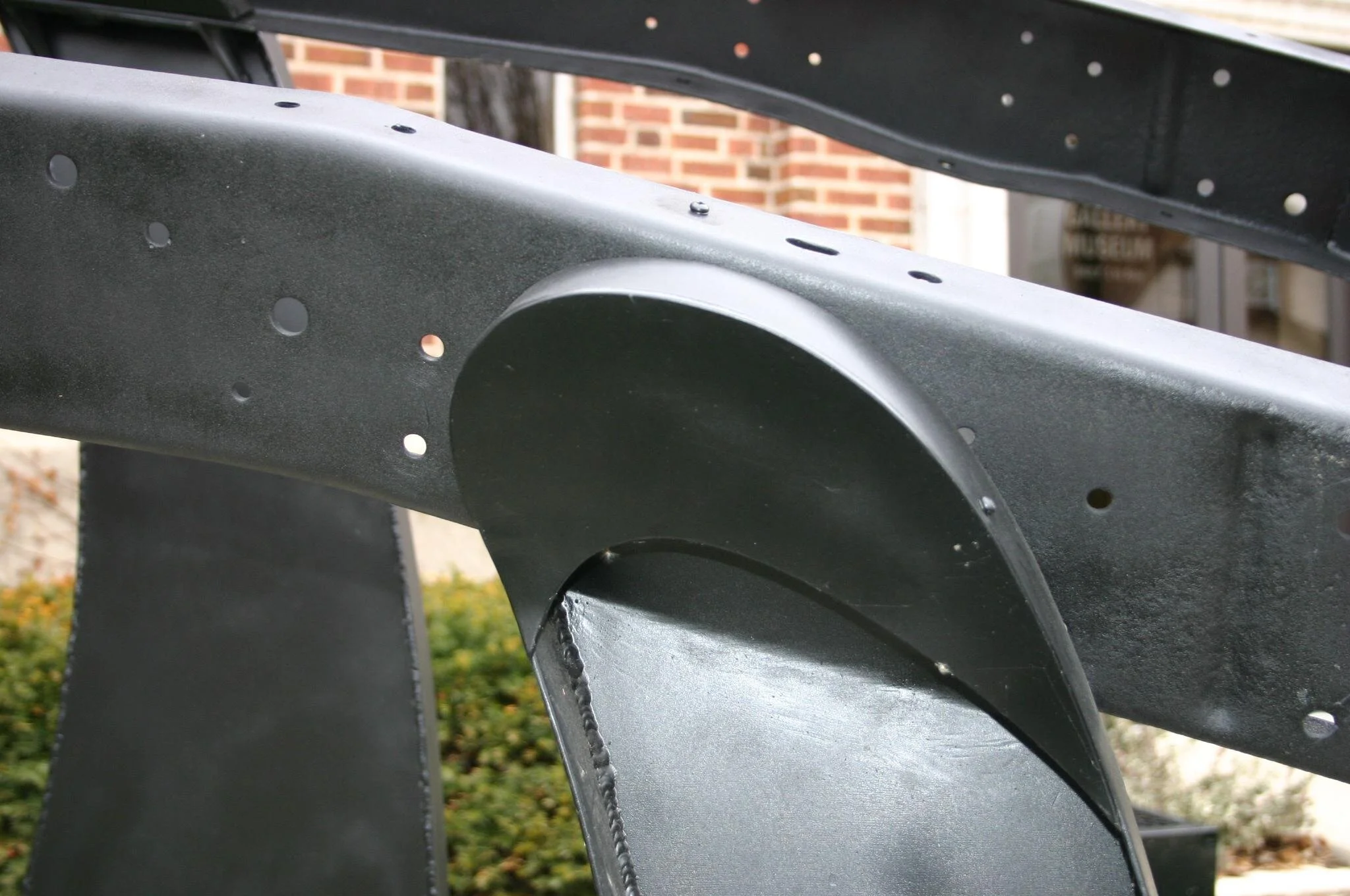
Shift’s playful equilibrium can be seen as an artful commentary on how human history continually repeats itself. The invisible 1966 Ford comes back to life in the viewer’s collective subconscious -- not as a recognizable frame but as a suspended double entendre of industrial and manufacturing expertise. At its core and re-fabrication, the celebration of humanity’s ability to rethink and recreate itself is carried through the narrative lines of the sculpture. As Picasso said in 1935, “art is not thought out and settled beforehand. It changes as one’s thoughts change. And, when it’s finished, it still goes on changing, according to the state of mind of whoever is looking at it. Art lives a life like a living creature, undergoing the changes imposed on us by our own life from day to day” (Ashton 8).
It’s not surprising that the technical skills of the influential American sculptor David Smith (a product of 60’s art culture) and Bernyk’s own creative expression reflect one another—albeit four decades apart. It was Smith who in 1977 stated that “arriving at a given form in the most efficient manner” offers the greatest opportunity for the audience to engage the work. Shift’s cool black exterior is a subtle reference to the oily ‘lifeblood’ fuelling the auto industry that laboured and formed this frame. In addition, it keenly expresses the skills of automotive assembly and the efficiencies of “arriving at a given form” with the materials at hand. Consequently, it’s not surprising that Bernyk was born and raised in LaSalle and Windsor, Ontario, centres of automotive manufacturing, especially during the 1960’s. It is equally unsurprising that Bernyk comes from a family with a history of factory work, something that must be seen as an essential influence on Shift’s creation. As a contemporary sculptor, Bernyk made this work’s presence felt in a world of cross-border aesthetics, where balancing the issues of socio-ideological information overload, protectionist public opinion, eco-friendly demands and personal aesthetic motivations must find a harmonious integration.
Bernyk’s fascination with steel and its endless possibilities to be modelled, hammered and bent, combined with his ability to alter its cool heart under his hands, reminds us of other Canadian post-minimalist sculptors, such as André Fauteux, Henry Saxe, and Robert Murray. Shift, in combining the skills of steel fabrication and the nuts, bolts and welds of industrial production, becomes more than an economy of creative form and function. The steel fabric that carries itself in space is not just a crucial aesthetic device or trope to reference creative expression or to emphasize the sculpture’s stability. It exists in an essential paradigm in sculpture of seen and unseen elements, things hidden and revealed, where, along with its inner road trip, is a world of external influences. The larger cultural picture of vintage preservation and innovation is pitted against the assimilation of old and new steel. The history of the unseen 1966 Ford assembly-line culture is exposed through the post-minimalist theories of balancing form, space and time in an act of musical counterpoint. As a result, Shift can be experienced both conceptually and physically, as a traveling platform where the viewer’s thoughts are carried on a journey down the factory line by the invisible dimension of time.
Given the current state of the industrial economy, Shift stands as a compelling response to a transforming era in which the mantras are to reclaim, recycle, reuse and reinvent. So, as you journey around the work, remind yourself to shift gears away from the simple form of minimalist detachment, and contemplate a sculpture where the past, present and future “lives a life undergoing the changes imposed on us by our own life.”
© Ken Giles 2009
Works Cited
Ashton, Dore, ed. Picasso on Art: A Selection of Views. New York: Viking, 1972.
Dan Bernyk interview at University of Windsor, School of Visual Arts, July 29, 2009
Einstein, Albert and Walter Shropshire (ed.), The Joys of Research, Washington, D.C.: Smithsonian Institution Press, 1981